
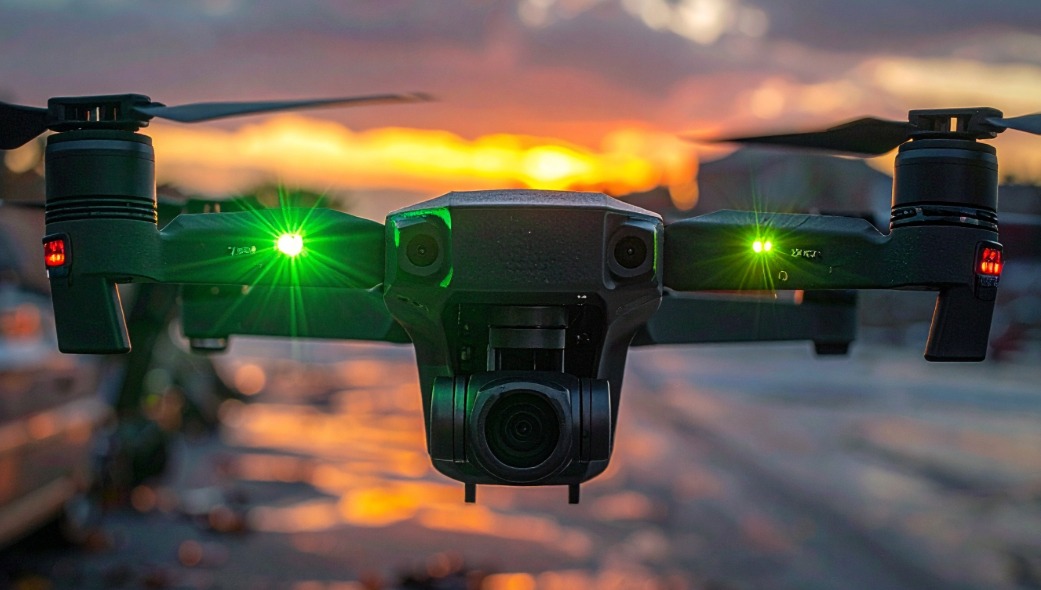

I’ll be honest: I had somewhat misunderstood the requirement for a green flashing light when flying at night. I’d always assumed it was primarily about making drones visible to other aircraft — a kind of airborne “see and avoid” system. Turns out, that’s not really the point.
According to recent UK Civil Aviation Authority guidance, if you’re flying a drone at night, you must have a green flashing light fitted and switched on. The stated reason? “Enabling a person on the ground to distinguish a drone from a manned aircraft.”
That wording is important. This is about general visibility and situational awareness, particularly for people on the ground or anyone nearby who needs to identify where your drone is. We might infer that much of this stems from the likes of the legendary Gatwick incident, which courts controversy to this day as to whether there actually was a drone in the airport’s perimeter or not.
There’s also a practical compliance point that’s easy to miss: if your drone doesn’t have a built-in green light, you’re required to fit one yourself, and that extra weight counts towards your drone’s total mass. That could push you into a different regulatory subcategory, which has knock-on effects for how and where you can fly. It’s a small detail, but operationally quite significant, at least if it is enforced to the letter.
Are standard frame LEDs sufficient, as on most DJI drones? My reading of the regulation is yes, as long as they remain active for the full duration of the flight. This means that any configuration to extinguish them when filming needs to be disabled, likewise extended use of a non-GPS flight mode.
The alternative is to fit an after-market strobe. We use these inexpensive units, fitting them with strong Velcro. We get at least an hour or so of use from a single USB charge.
Now, here’s where I remain slightly sceptical.
The logic seems to be that a green flashing light makes drones more visible — fair enough. But will it actually prevent drones being mistaken for manned aircraft? I’m not convinced. Traditional aircraft lighting conventions already include green navigation lights (typically on the starboard wing), so adding more green lights into the night sky doesn’t obviously reduce ambiguity. If anything, it might increase it for the untrained observer.
That said, the requirement perhaps isn’t solely aimed at making drones look different from aircraft — it’s about making them visible at all. And given how quickly a drone can disappear into the night sky (even at relatively low altitudes), that’s a reasonable safety objective.
It’s also worth remembering that although this clarification focuses on the broad Open Category framework, the regulation is replicated in the Specific Category.
Since January 2026, this lighting requirement has become a standard part of the regulatory landscape, alongside other changes like Remote ID and updated classification rules. So if you’re flying after dark, this isn’t optional — it’s a baseline compliance requirement.